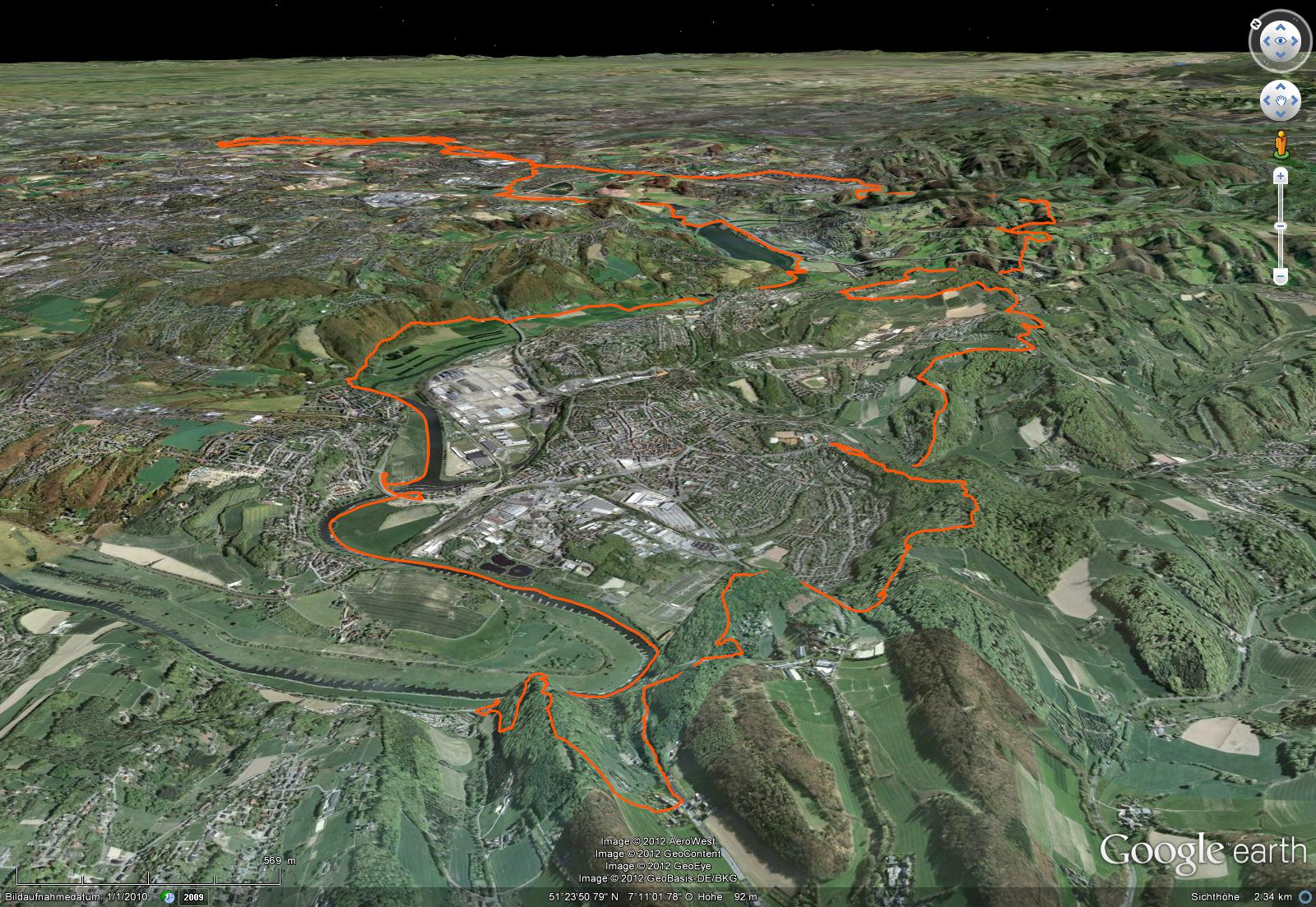
Witten, Ruhrhöhenweg, Isenburg
Posted by Jaran
on 2012/07/07
No comments


Externsteine, Hermannsdenkmal
Posted by Jaran
on 2012/06/21
No comments
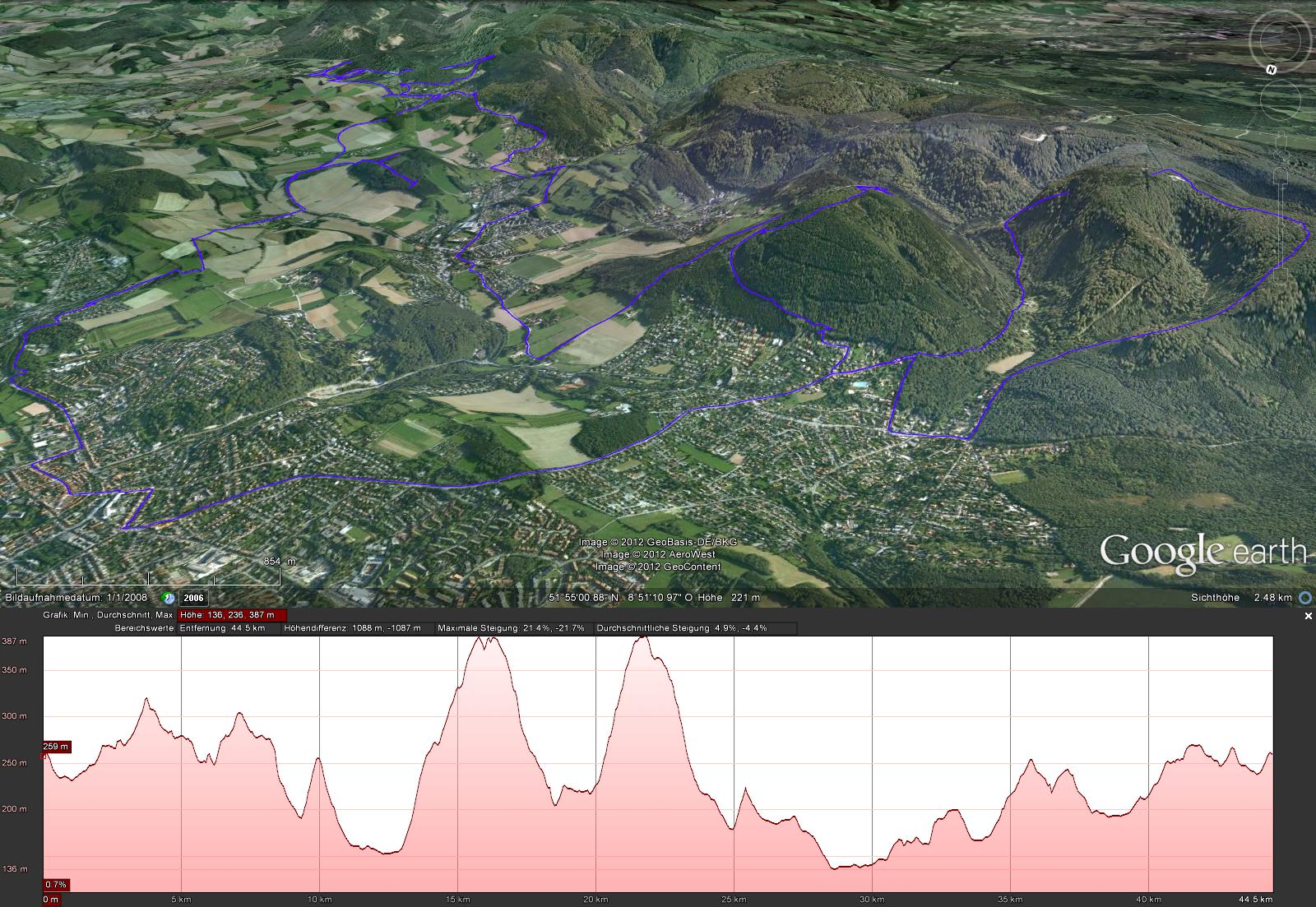
Haard, Haltern, Hohe Mark, Dülmen
Posted by Jaran
on 2012/05/19
No comments
Today I biked 66km through the “Naturpark Hohe Mark” when I found this near Reken:
Read more »
Rendering a Gigapixel Buddhabrot (Part One)
Posted by Jaran
on 2012/02/11
No comments
This is a followup to my What is a Buddhabrot anyway?-post where I only described the mathematical backgrounds of the Mandelbrot Set and its relationship to Buddhabrot renderings. This post will describe how I actually created the images.
As described in the linked article above one needs to find such points for which the Mandelbrot iteration becomes unbounded. Then one draws each point of such an unbounded iteration, repeats that for lots of other points and gets a Buddhabrot.
While the words sound easy enough, there are certain problems: how does one know that an iteration becomes unbounded when unbounded basically means that “it never ends up somewhere”. And then how do we find those interesting points and moreover lots of them within a lifetime?
Luckily it has been found out that if the continued iteration results in points that are farther than 2 units away from the origin of the coordinate system, that this iteration is unbounded. That means that if we started with a point that leads to an unbounded iteration we will sooner or later know it and can stop iterating.
However, if we started with a point that leads to a bounded iteration it will never lead to points farther than 2 units away from the origin and if we don’t stop using some other criterion we will have an infinite loop. This other criterion is quite simple: set some maximum iteration count and whenever you exceed it consider the iteration bounded and thus not interesting for the Buddhabrot rendering.
Read more »
Upgrading a Lenovo IdeaPad S205 with an SSD and more RAM
Posted by Jaran
on 2012/02/04
5 comments
Since my 5 year old Sony Vaio Laptop is in the process of disintegrating I bought a Lenovo S205 netbook. Additionally I ordered another gig of RAM (the S205 came with 1 GB) and a 60GB OCZ Vertex Plus SSD.
It’s always good to know what you’re up to before taking up the screwdriver so I took a look at the S205s Hardware Maintenance Manual (direct link to the PDF) and off I went with disassembling the netbook:

After careful removal of the old harddrive, replacement with the SSD and adding the additional gigabyte of RAM it was ready to be closed up again.

After some trouble with installing Windows XP (I had to slipstream Service Pack 3 into the installation CD to make it work) all the work was definitely worth it:

If you’re going to install an SSD, be sure to read about partition alignment first, especially if you’re installing Windows previous to Vista!
MySQL: From Differences to Gains and Losses
Posted by Jaran
on 2012/01/09
1 comment
The problem with blogging solutions specifically for one person is that he comes back and asks for more 😉 Luckily this time it’s easier!
What we got: a simple table with one column whose values describe a difference of some kind. That is we got one column called difference, that has negative or positive (or 0) numbers.
What we want: we’re looking for the most simple and performant way to update two other columns from that difference one: if the difference was positive, this value is to be updated into a gain column. If it is negative, then the positive value (the absolute value) is to be updated into the loss column.
Rankings in MySQL – global ranks and local ranks within subsets
Posted by Jaran
on 2012/01/08
3 comments
I was asked by someone to help him figuring out how to calculate and store rankings in an SQL relation. There are already some resources on the web that show how to calculate rankings with MySQL but the specific problem today has two more facets to it:
- don’t calculate a single rank of one item but update all ranks of all items in one query
- not only calculate the global rank of each item but also the rank of each item within some subset it is part of


Recent Comments